


Mathematics Hidden in Shattered Glass — Can you imagine?
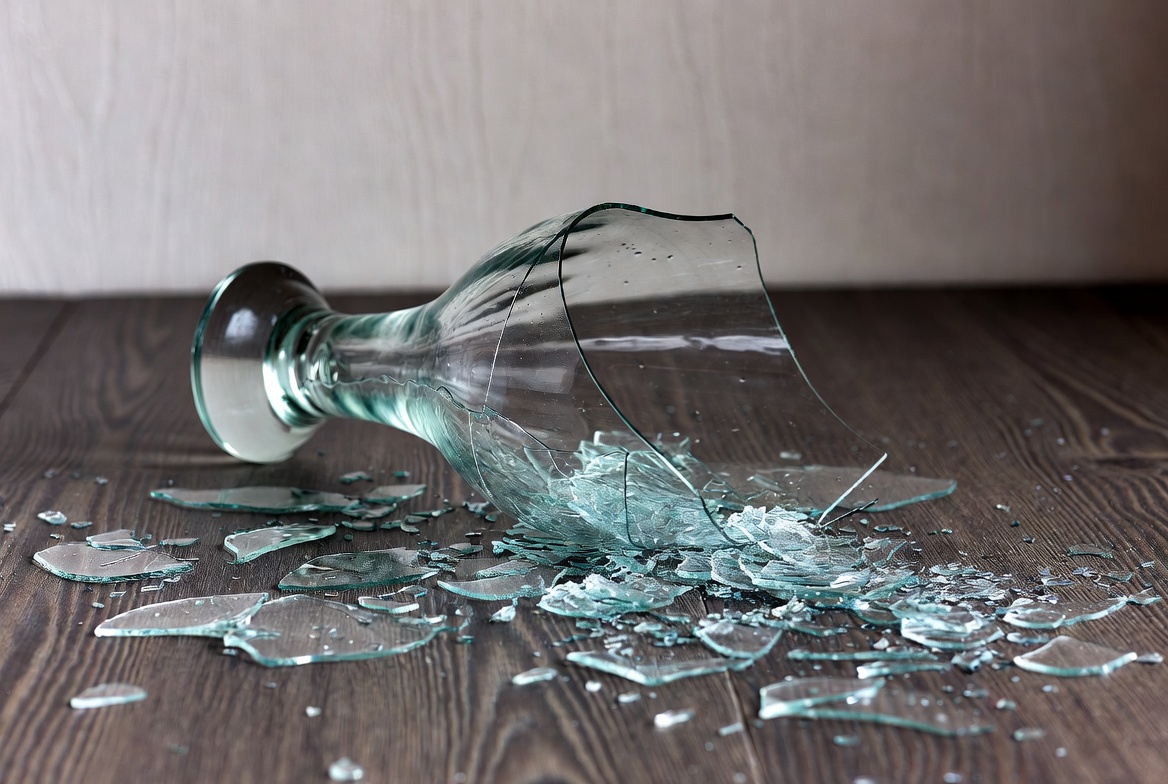
On a spring afternoon, a beautiful flower vase sits on a table by an open window, filled with fresh roses. Suddenly, a strong gust of wind blows in. The vase falls—and shatters. In an instant, it’s reduced to pieces scattered across the floor.
When you look at those glass shards spread everywhere, what do you see? Pure randomness, right? Some pieces are large, some medium-sized, others reduced to tiny splinters. At first glance, it feels like complete chaos. But according to French researchers, that’s not quite true.

Scientists say that even within this apparent disorder, nature follows a remarkable mathematical rule.
A French researcher from Aix-Marseille University, Emmanuel Villermaux, has put forward a fascinating idea. He argues that when an object breaks, it doesn’t do so arbitrarily. Instead, the process is governed by a fundamental principle of the universe known as entropy.
Simply put, entropy is a measure of disorder. The universe constantly tends toward states of greater disorder. Villermaux’s theory suggests that when an object shatters, it does so in a way that maximizes disorder—or maximum entropy.
This idea isn’t just theoretical. Scientists went a step further and conducted real-world experiments, smashing sugar cubes and other brittle materials. The results were striking. They found that the sizes of the broken fragments follow a precise mathematical pattern known as a power law.
Here’s how it works: when something breaks, there are always more small pieces than large ones—something we intuitively understand. But the exact ratio between large and small fragments isn’t random. It follows a specific mathematical curve. Whether it’s a glass, a clay pot, or a lump of sugar, the way it breaks is governed by the same underlying formula.
That said, no rule is without exceptions. Researchers note that this mathematical law applies especially well to hard, brittle materials. Softer plastics or certain liquids don’t follow the same pattern when they break or deform. Those materials tend to fail in more orderly ways.
This discovery is highly significant in the field of materials science. Understanding these patterns allows scientists to predict, in advance, what debris will look like when a material fails—knowledge that can be crucial in engineering, safety design, and industrial applications.
Read more in FEATURE


